

Why knowing what motivates your team changes everything
Every leader knows the frustration; you have talented people, a clear strategy and a genuine desire to build a high-performing team but something is missing. People disengage, performance plateaus and staff turnover quietly drains the organisation of knowledge and momentum. The reason, more often than not, is not a skills gap. It is a motivation gap.
Motivational Maps is a powerful, scientifically grounded tool that helps individuals, managers and organisations understand precisely what drives each person at work and critically, what to do about it. Where many personality profiling tools focus on behaviour or cognitive style, Motivational Maps goes straight to the source, the needs and desires that, when satisfied, generate energy, commitment and performance.
“People are not machines. They are motivated by fundamentally different things — and what motivates them is not fixed. Motivational Maps makes the invisible visible.”
Drawing on the work of Abraham Maslow, the Enneagram and career anchors theory, the Maps framework identifies nine distinct motivators, grouped into three clusters: Growth (the drive to develop and expand), Achievement (the drive to produce results and gain recognition) and Relationship (the drive to connect, belong and contribute). Every person holds all nine motivators to some degree, but typically two or three dominate and those are the levers that, when pulled, unlock discretionary effort, facilitate engagement and increase productivity and well-being.
In the sections below, we explore each of the nine motivators in turn, describing the core need it represents, what it looks like in practice and the reward strategies most likely to satisfy it.
The Nine Motivators

1. The Searcher
Purposeful · Feedback-orientated · Quality critical
At the heart of the Searcher motivator is a deep need for meaning. Searchers need to believe that what they do matters, not because it earns them money or status, but because it has genuine value in its own right. They want to make a difference, contribute to something worthwhile and see the bigger picture of how their efforts connect to a wider purpose. Routine, repetitive, or impersonal work is likely to be demotivating for them because it undermines that sense of significance.
A Searcher in the right environment is curious, committed and quality-focused. They are frequently the most customer-centric people in a team, because their entire orientation is towards making things better for others. Remove the sense of purpose and they are the first to quietly disengage.
Reward and Engagement Strategies:
- Provide regular, specific feedback on how their work is making a difference
- Connect individual goals visibly to the broader organisational mission
- Involve them in significant, meaningful projects, not repetitive tasks
- Share customer testimonials and positive outcomes that result from their work
- Offer mentoring relationships and opportunities to contribute to quality improvement

2. The Spirit
Independent · Choice-orientated · Decisive
The Spirit motivator is driven by freedom and autonomy. Spirits need to feel that they are in control of how they work, make their own decisions and are trusted to proceed without constant oversight. Bureaucracy, micromanagement, and rigid procedures are not merely inconvenient to a Spirit, they are genuinely stressful and will reliably destroy motivation over time. The Spirit often has an entrepreneurial energy, they work best when set a clear objective and then given the latitude to achieve it in their own way.
High-Spirit individuals are often the most self-sufficient and emotionally resilient members of a team. They can endure pressure and uncertainty, provided they retain a sense of control. Remove that control and they will either push back against authority or seek their freedom elsewhere.
Reward and Engagement Strategies:
- Delegate genuinely, give responsibility without constant check-ins
- Reward with autonomy, flexible hours, remote working, self-directed projects
- Avoid micromanagement in all its forms
- Share the company vision and allow them to decide how best to contribute
- Create space for independent thinking and self-directed development

3. The Creator
Innovative · Solution-orientated · Cutting-edge
The Creator’s core need is for creativity and originality. They are motivated by innovation and by bringing into existence something that did not previously exist. Problems excite them. Novelty energises them and routine kills them. Creators thrive on change, variety and the opportunity to express original thinking. They want their name on the output, the product, the solution, the idea and they feel a very particular ‘play buzz’ when creative work is going well. They are typically optimistic and can persevere through adversity because the challenge itself is motivating.
In a team context, Creators are your change agents and your problem-solvers. They are happiest in small, focused groups with the freedom to explore. Confine them to routine tasks for too long and the energy visibly drains from them.
Reward and Engagement Strategies:
- Give them real problems to solve; frame challenges as opportunities, not burdens
- Minimise routine and paper-driven tasks wherever possible
- Reward innovation explicitly; credit them for their ideas
- Provide a stimulating physical environment that encourages creative thinking
- Involve them in brainstorming, product development and process improvement

4. The Expert
Insightful · Learning-orientated · Knowledgeable
The Expert motivator is built on a need for mastery and expertise. Experts seek to be the very best at what they do, to achieve technical excellence in their chosen field. For them, being unable to demonstrate competence is acutely stressful. Training opportunities are not merely welcomed they are craved. The Expert wants to be the go-to authority, the craftsman, the specialist and they will actively pursue development rather than waiting for it to be offered to them.
Experts are valuable in any organisation that relies on specialist knowledge. Their intellectual rigour and commitment to continuous improvement raise the quality of everything they touch. The risk is that they can become narrow or disdainful of generalists, but when recognised for their depth of knowledge, they are extraordinarily loyal and productive.
Reward and Engagement Strategies:
- Invest actively in training, development and professional qualifications
- Position them as internal mentors or subject-matter authorities
- Ensure appraisal discussions include specific development goals, not just performance targets
- Provide access to conferences, industry networks and other expert communities
- Create job titles and role descriptions that formally recognise their expertise

5. The Builder
Commercial · Goal-orientated · Competitive
The Builder’s primary motivation is material success. Builders are driven by money, financial rewards and a high standard of living. They are highly goal-oriented and competitive, not simply because they enjoy winning, but because winning typically comes with tangible rewards. Pay rises, bonuses, commissions and visible perks are all deeply motivating. They measure success materially, benchmark themselves against others and will consistently pursue higher earnings and better rewards.
Builders are the most commercially focused of all the motivational types. They bring energy, competitive drive and results-orientation to any team. The key to managing them well is ensuring that performance and reward are clearly and explicitly linked. They need to see a direct line between effort and outcome.
Reward and Engagement Strategies:
- Link goals directly and explicitly to financial rewards, bonuses and commissions
- Use competitive formats; leaderboards, team contests and performance-related incentives
- Offer clear career paths with visible increases in earning potential at each level
- Provide material perks (perhaps vouchers, gifts, experiences) tied to achievement
- Communicate the “earn more, learn more” principle. Invest in their development and explain the financial upside

6. The Director
Responsible · Power-orientated · Influential
The Director is motivated by power, influence and control. They want to be in charge of people, resources, decisions and outcomes. Being an anonymous contributor in a large organisation leaves them cold. Having real responsibility and the authority to shape how things are done energises them. Directors are naturally drawn towards management and leadership roles and they tend to have high self-confidence and clarity of purpose. Giving them responsibility is one of the most powerful motivational tools available.
Directors are decisive, purposeful and effective at driving action. The challenge in teams of Directors is that competition for control can fracture cohesion, each individual vying to set the agenda. Channelled well, however, their drive for dominance becomes a tremendous organisational asset.
Reward and Engagement Strategies:
- Delegate meaningful responsibility with genuine authority, not just tasks
- Offer role titles that reflect their level of power and influence
- Provide regular Personal Development Plans focused on leadership growth
- Create opportunities to represent the department or deputise for senior leaders
- Involve them in strategic decisions and critical discussions

7. The Star
Recognition-driven · Status-orientated · Hierarchical
The Star motivator is centred on a need for recognition, status and public esteem. Stars want to be noticed, admired and respected not just within their team, but within their profession and community. Promotion is motivating to a Star not primarily for the financial benefit but for the recognition it confers. Awards, positive public feedback, high-visibility roles and being taken into the confidence of senior leaders all speak directly to this motivator. They are acutely aware of hierarchy and measure their progress through the lens of esteem.
Stars bring ambition, competitive drive and a powerful desire to excel. Their need to shine can occasionally create friction when recognition is scarce but managed with regular, visible acknowledgement, they are among the most energised and high-performing contributors in any team.
Reward and Engagement Strategies:
- Recognise achievements regularly and visibly. Little and often is far more effective than occasional grand gestures
- Involve them in high-profile projects and public-facing work
- Create formal award mechanisms such as employee of the month, industry award nominations, internal newsletters featuring their achievements
- Provide clear career pathways that offer visible progression in status
- Consult them on key decisions; being seen as an insider is deeply rewarding

8. The Friend
Connector · Involvement-orientated · Supportive
The Friend motivator is rooted in a need for belonging, connection and meaningful relationships. Friends want to feel that they are part of a community at work, that they are liked, included and valued as a person, not just as a function. They view every change through the lens of “how does this affect the people here?” Loyalty and continuity are central values. They will often stay in a role they do not love simply because they love the people around them. A good social life at work is intrinsically motivating.
Friends are the natural team players, the glue that holds groups together in difficult times. When stress rises and things get hard, it is often the Friend-motivated individual whose mutual support carries the team through. They are worth their weight in gold, but they need to feel genuinely included to give their best.
Reward and Engagement Strategies:
- Foster a genuinely collaborative, inclusive team culture
- Involve them in team decisions and consult them regularly
- Organise social events and make them feel natural, not forced
- Recognise loyalty explicitly, both informally and at appraisal
- Assign them mentoring, buddy or coaching roles that leverage their relational strengths

9. The Defender
Stable · Security-orientated · Accurate
The Defender’s core need is for security, stability and predictability. Defenders want to know that what they are doing is building towards a safe, certain future both for themselves and the organisation. They value clear roles and responsibilities, accurate and regular information and the continuity of a well-established structure. Bold moves are not beyond them, but only when careful calculation demonstrates that the outcome is likely to be secure. Uncertainty, ambiguity and sudden change are genuinely stressful for the Defender.
Defenders are precise, reliable and deeply committed to getting things right. They are the people who check, double-check and ensure that data is accurate and systems work. In environments where stability and accuracy matter (i.e. most organisations) Defenders are an invaluable asset.
Reward and Engagement Strategies:
- Communicate clearly, consistently and frequently particularly during periods of change
- Provide clearly defined roles, responsibilities and expectations in writing
- Link their personal goal achievement explicitly to organisational security and continuity
- Offer perks that reinforce security; pension enhancements, healthcare provisions, loyalty schemes
- Create and publish plans, remove ambiguity about what is happening and when
Putting Motivational Maps to Work
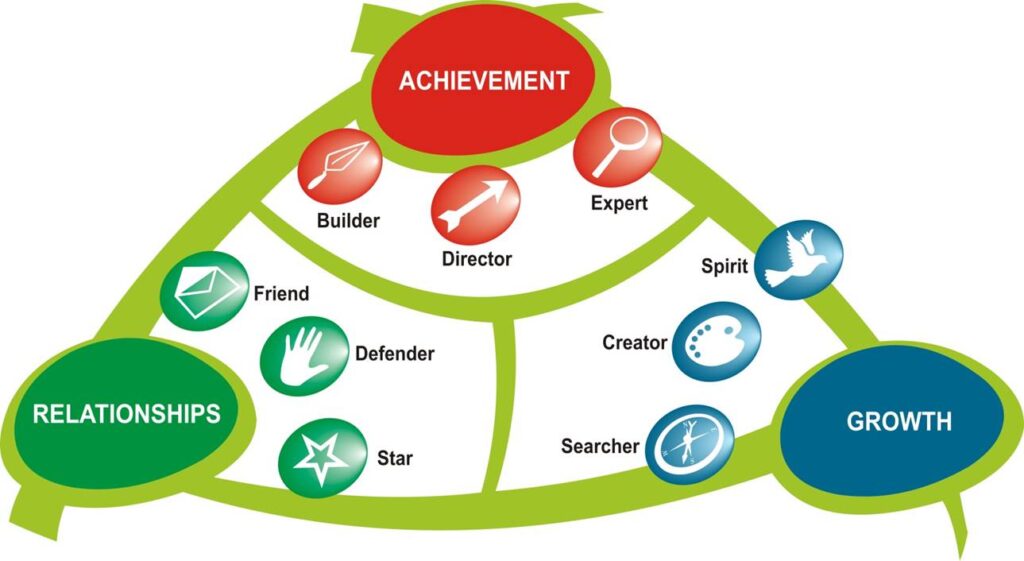
Understanding the nine motivators is only the beginning. The real power of Motivational Maps lies in its application, both at an individual level and across teams and organisations.
For individuals, a Motivational Map provides a clear, personalised picture of what is currently driving them, how satisfied those needs are and what strategies they can adopt to increase their own motivation and performance. It’s a catalyst for self-awareness and meaningful conversation.
For managers and leaders, the Maps reveal why different people in the same team respond so differently to the same rewards and the same leadership style. A Director-motivated individual may thrive when given responsibility and authority; the same approach will feel overbearing to a Spirit. A Star needs public recognition; a Friend may prefer a quiet word of personal appreciation. Maps gives leaders the insight to lead in a genuinely personalised way, without guesswork and in the knowledge that they can positively maintain or enhance motivation across their team.
For recruitment and executive search, Motivational Maps adds a dimension that CVs and competency interviews rarely capture. Will this person be truly motivated in this role, in this culture or reporting to this leader? Assessing motivational fit alongside skills and experience substantially reduces the risk of a costly mis-hire and increases the probability of long-term success for both candidate and client.
Importantly, motivators are not fixed. They shift over time in response to life events, career transitions, organisational change and personal growth. A regular Maps assessment (annually, or at key career moments) ensures that the picture remains current and the conversation stays alive.
More information about Motivational Maps can be found here;