We can’t actually measure employee engagement according to a recent Forbes article. The piece, written by Susan LaMotte, argues that despite a booming industry of surveys, dashboards and AI driven pulse tools, organisations still struggle to turn engagement data into real business impact. Leaders are drowning in numbers but starved of insight. In response to LaMotte’s point I’d suggest that engagement can be measured reliably, but only once you start measuring motivation rather than sentiment.
It’s a fair critique of how most organisations currently approach engagement. But the conclusion that measurement itself is the problem deserves a challenge. The real issue isn’t that engagement can’t be measured. It’s that most tools measure the wrong thing and stop the process at the data rather than using the data as the start of a conversation.
Can You Really Measure Employee Engagement?
The Forbes article raises genuine and important concerns. Traditional annual surveys are indeed a lagging indicator that tells you how people felt months ago rather than how they feel now. They are also aggregate scores often averaging out the sentiment of a wide range of employees. Percentage scores make for tidy dashboards but rarely explain why a team is disengaged or what to do about it and as Jeffrey Lackey of JKL Advisors puts it in the article, a survey is no substitute for a conversation.
These are real weaknesses. A single sentiment score, refreshed once a year and handed to a manager as a grade, was never going to change behavior. If that’s the only model of engagement measurement someone has encountered, it’s entirely reasonable to conclude that measurement doesn’t work. Pulse surveys too are influenced by very short term sentiments if, for example, an employee has just missed a promotion and heads straight to the engagement survey.
The Missing Distinction: Motivation Is Not the Same as Sentiment
Where the argument runs into trouble is in what it chooses to measure. Engagement surveys typically ask people how they feel about their job right now. That’s sentiment and sentiment is volatile by nature. It shifts with a difficult client call, a delayed pay rise, or a bad night’s sleep. Measuring something this changeable with an annual snapshot was always going to produce stale, unreliable data.
Motivation is different and more stable. It’s not how someone feels today. It’s what actually drives them, the underlying psychological needs that determine what kind of work energises them and what kind of work drains them. Some people are driven by autonomy and the freedom to solve problems their own way. Others by recognition, by the security of a well ordered role, by the chance to lead or to belong to a strong team. These drivers don’t change week to week. They can and do change over time as does the degree to which these drivers are fulfilled, but they’re closer to a trait than a mood and that’s precisely what makes them measurable in a meaningful and durable way.
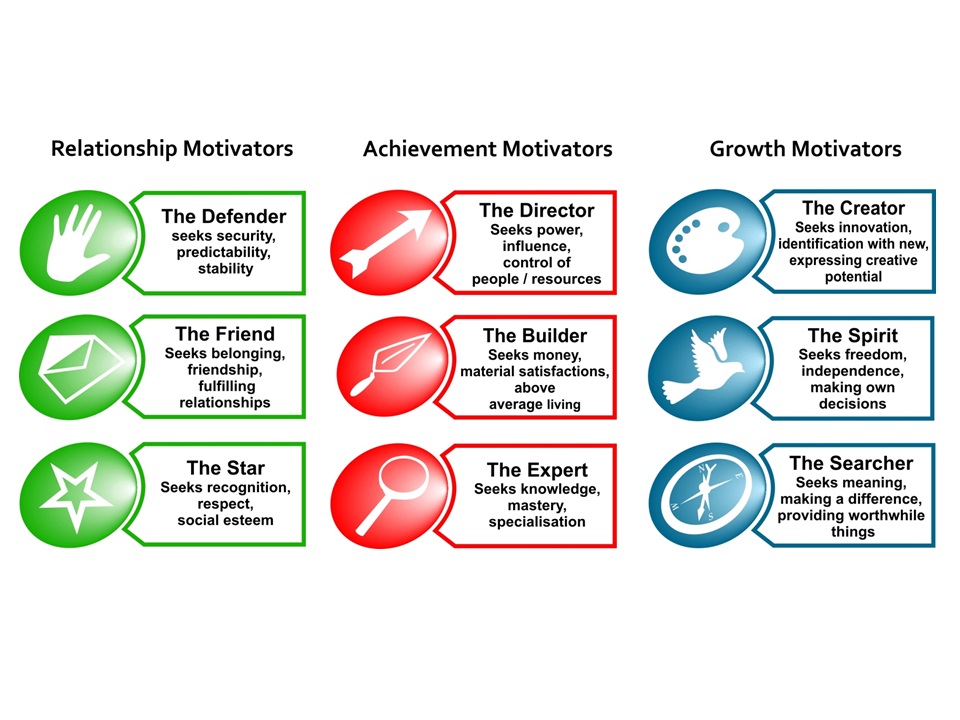
This is the foundation of the Motivational Maps® framework, which identifies nine core motivators, from Searcher and Creator through to Director, Star and Defender and produces an individual or team map showing which of these drive a person most strongly and how well fulfilled they are. Because it measures the driver rather than the daily mood it doesn’t suffer from the volatility problem the Forbes article rightly criticises in traditional engagement surveys.
Five Questions
The Forbes piece poses five searching questions any organisation should ask of its engagement data. It’s worth testing motivational mapping against each one.
Are we getting the right data?
The article argues that a survey should never be a substitute for a conversation. A properly run Motivational Map agrees entirely and builds the conversation into the process rather than treating it as an optional extra. An online questionnaire produces the map but the map is only the starting point. Every individual program and every team program includes a structured debrief where a trained facilitator sits down with the person or the team leader to interpret what the data actually means for them.
Are we measuring the right thing?
Traditional engagement surveys blur the line between employee sentiment and manager performance which leaves managers being scored on things they can’t control. Motivational mapping avoids this confusion by focusing squarely on what drives the individual, not on grading the manager. A team leader isn’t handed a scorecard of their own performance. They’re handed a clear picture of what motivates each member of their team so they can adapt how they lead, reward and communicate accordingly.
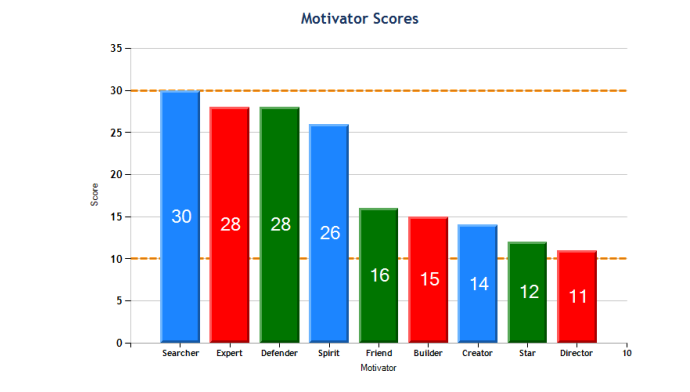
Take Sofia’s ‘map’ below for example. Sofia is a field-sales rep. based in Cincinnati covering the tri-state area. Her top motivator is ‘Searcher’ meaning she is driven by meaningful, purposeful work where she can have an impact. She prefers to see the big picture and wants to make a difference. Feedback for Sofia is critical, otherwise how will she fully appreciate the impact her work is having on the organisation? Her manager will need to ensure she gets the feedback she needs. Meanwhile, her lowest motivator is ‘Director’ so she gets little energy from having control over people or budgets. It would most likely be a mistake to move Sofia into a regional sales management position for example.
One of the beauties of the Motivational Map is that it provides a tool and a language that facilitates crucial conversations around motivation at work.
Are we accounting for business reality?
This is perhaps the strongest point in the original article. Sentiment changes with circumstance and a once a year measure will always be out of date within weeks. But because motivational drivers are more stable than sentiment they don’t carry the same expiry date. A map taken today still gives a leader an accurate and useful picture of what fuels a person’s energy for many months to come, even as day to day business pressures shift around them. If however, there were a major change in circumstances, updating the map would be wise so any changes in motivation can be seen and a further conversation had.
Are we relying too much on technology?
The article’s warning here is well made. Dashboards and AI driven insights can’t replace the empathy needed to understand why someone feels the way they do. Motivational mapping is designed around this exact principle. The report is data but the value is unlocked entirely through human dialogue. A debrief session is where a facilitator explores a person’s strongest and weakest motivators, asks how well fulfilled they currently are and works through what reward and engagement strategies would genuinely help. No algorithm makes that judgment. A person does, in conversation with another person.
Are we making a business impact?
This is where the case for motivational mapping is strongest. The Forbes article notes that leaders often applaud or despair over a score without it driving real change. A Motivational Map is built to avoid exactly that outcome. Because it identifies specific fuel sources for each individual, the debrief moves directly into action such as which reward levers to pull, which responsibilities to reshape and how to keep a well motivated person’s tank full, rather than leaving leaders with only a number and no next step.
The Real Lesson
The Forbes article is right that data alone changes nothing. Where the argument falls short is in treating that as evidence measurement can’t work rather than evidence that most organisations are measuring the wrong variable and skipping the conversation that turns a data point into a decision.
Motivation can be measured reliably because it’s a more stable underlying driver rather than a fleeting mood. Once that data exists, dialogue between an employee and a coach or between a team and its leader is what converts a report into real improvement in motivation and engagement at work. Neither the data nor the conversation is sufficient alone. Together they’re what the past decade of engagement measurement has been missing.
If your organisation has been collecting engagement scores for years without seeing the needle move it may not be time to abandon measurement altogether. It may be time to measure something more durable and pair it with the conversation that was always meant to follow.